250th Anniversary of the American Revolution - Wainscott History
250th Anniversary of the American Revolution
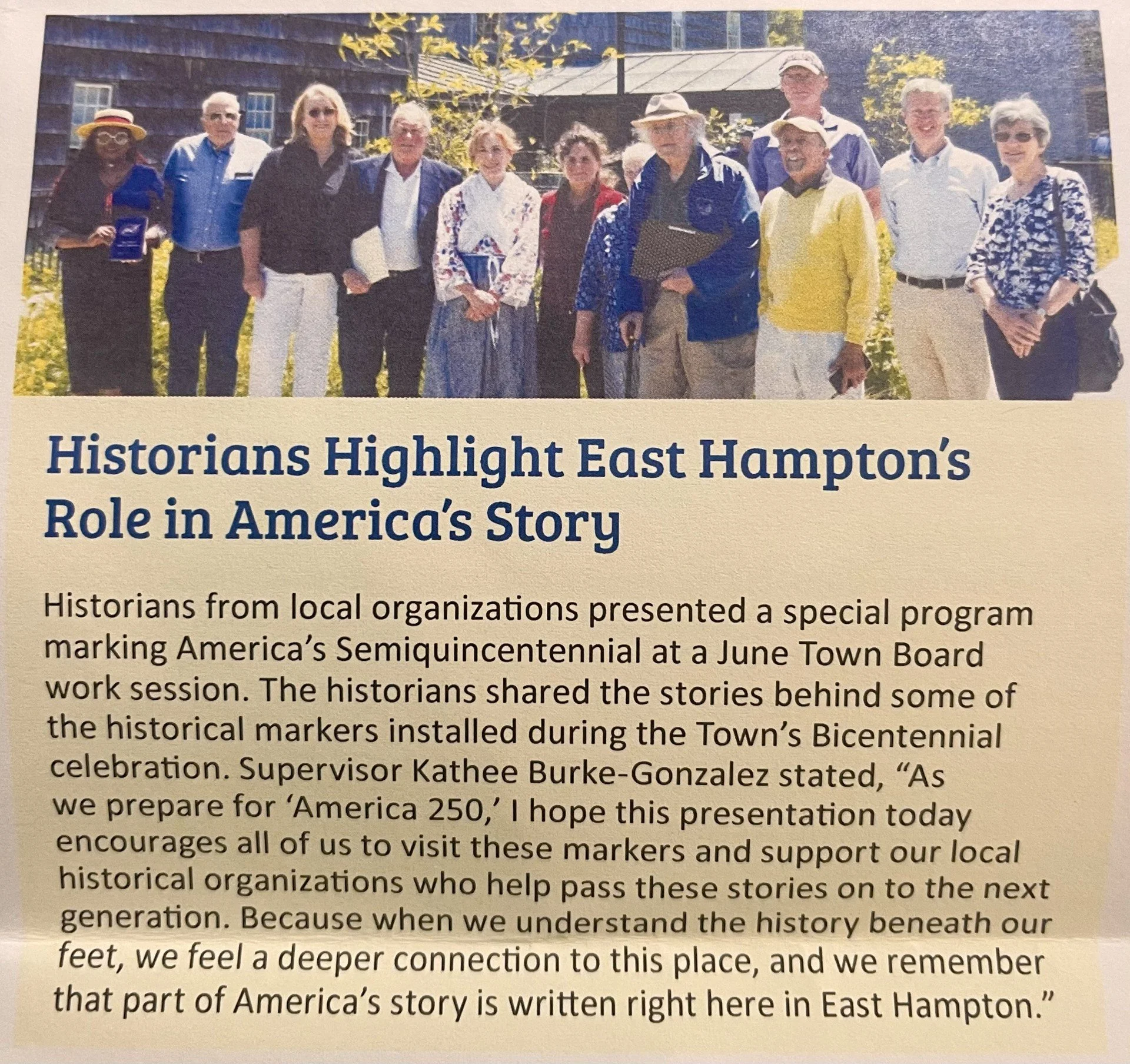
As presented to the East Hampton Town Board Work Session on June 2, 2026
Founded in 1869, the Wainscott Sewing Society is one of the oldest women’s organizations in New York State. Originally, our members gathered to sew clothing for children in New York City orphanages and to fund local civic projects, like a new sidewalk or a cemetery fence.
Today, our mission focuses on the care and upkeep of the Wainscott Chapel, a non-profit community center on Wainscott Main Street that was established in 1908.
Americans have been quilting since the early 1700’s. Our Sewing Society quilters, recently completed an impressive history quilt. Each square highlights a piece of Wainscott’s heritage, showcasing our farming, fishing, and whaling history, our notable crops of strawberries and potatoes, and the beauty of the ocean meeting Georgica Pond. It also features iconic landmarks like the Osborn General Store, the Wainscott Chapel, and the Wainscott Windmill. The quilt will be on permanent display at the Wainscott Chapel.
Wainscott’s independent streak goes back to its very founding. In 1670, John Osborn, one of the first East Hampton settlers—left East Hampton in search of more room for his family. He settled on the expansive plains surrounding Wainscott Pond. Residents once proudly called themselves 'Wainscott Dumplings.' The nickname came from an unfortunate cook whose dumplings were reportedly so tough they couldn't be chewed!
Tragedy struck the community, in 1772, years before tensions escalated into a full-scale war. Jedediah Osborn of Wainscott was tragically killed in an accident during a colonial muster drill.
His gravestone in the Wainscott Cemetery bears a touching tribute that reads:
‘This monument erected by Col. Gardiner, Capt. Mulford and Lieut. Dayton and their soldiers in memory of Jedidiah Osborn, who was killed by the discharge of his arm, Nov. 30, 1772, in the 21st year of his age. How sudden was my death, life is but fleeting breath.’
These officers were all local men, who would soon become prominent leaders in Suffolk County’s Revolutionary War efforts.
The defiant, unyielding character of 'Wainscott Dumplings' is evident in the stories of two women who refused to back down to British soldiers during the occupation of East Hampton. These accounts were preserved on a handwritten slip of paper found tucked inside an early 1900s diary belonging to Louisa Edwards Osborn.
The first story involves Mercy Schellinger Osborn. Her husband, Zebedee Osborn, in 1775 signed the Revolutionary Association, to show open support for the American quest for independence. Rather than live under hostile British military rule, he fled with his family to Connecticut as a refugee in 1776. Falling on hard times, he petitioned to return home five years later.
One day, while riding from Poxyabogue to Wainscott on horseback, Zebedee’s wife, Mercy, was intercepted by a British soldier who demanded she identify herself.
She looked him in the eye and defiantly declared: “I am the mother of Zebedee’s children. I am attending to my own business, and you would do well to attend to yours.”
Stunned by her boldness, the soldier replied, “Go on. We don’t want anything to do with you!”
By identifying herself as Zebedee’s wife, Mercy was boldly announcing, to an occupying army, that she was a rebel. She was described as a resolute woman.
The second story is about Amy Miller, believed to be Amy Mulford Miller, wife of Lieutenant John Miller of the Suffolk County Minute Men. Amy lived in a small house on a parcel known locally as the 'Bill Lot' in Wainscott.
One afternoon, she discovered a British soldier standing inside her chicken coop, holding one of her roosters. Indignant, Amy grabbed an ax, marched up, and warned: “If another of you dares to step a foot in here, I’ll split your brains out with an ax, I will!”
One soldier turned to the other and muttered, “She’d make a good soldier.”
Amy raised the ax higher and snapped: “Now, none of your lip!'"
These stories capture the fierce spirit of local women who used their wit and defiance to protect their homes and farms, and prevent the British from plundering their livestock, crops and wood piles.
This year, to celebrate the 250th anniversary of American independence, the Wainscott Sewing Society is honoring the past, with traditions that keep our community connected. We invite all of you to join us for our upcoming events:
· A Strawberry Festival on June 21st
· A history talk titled Strange but True - Stories of Wainscott Past on August 1st
· A community Ice Cream Social on October 3rd
· Rummage Sale on August 22nd
· And a Community Potluck Supper on November 13th
Attendance is open to anyone who shares an appreciation for this beautiful community by the sea.